

Data Centres Start with Design Excellence

In an era defined by digital acceleration, the backbone of our connected world is often invisible-but absolutely essential. Behind every app, website, cloud service and online transaction is a powerhouse of computing and connectivity: the data centre. As demand for seamless digital experiences grows, one truth becomes increasingly clear-data centres start with design excellence.
Why Design Matters in Data Centres
A data centre involves far more than a large room filled with servers. It’s a mission-critical environment built to house, power, cool and secure IT infrastructure. From hosting cloud services to storing and processing vast amounts of data, data centres are the technological hubs driving business operations globally. But their performance, efficiency and scalability hinge on how well they are designed from the ground up.
Design excellence extends beyond architecture-it’s about aligning physical infrastructure with long-term business needs, operational efficiency and technological evolution.
What Makes a Data Centre Buzz?
Modern data centre design and construction comprises two core components: the facility and the IT infrastructure it supports.
The Facility
The physical space of data centre facilities, or data centre architecture, must cater to various operational demands:
The Infrastructure
Inside, the heart of the data centre beats with:
Designing a Data Centre
Data centre design architecture requires meticulous planning and technical foresight. It starts with aligning facility capabilities with projected IT demands by certified data centre design professionals, while adhering to rigorous global standards such as:
Design must address:
The Art & Science of Space
Designing the physical layout of a data centre is both an art and a science. Server racks-organised into hot and cold aisle configurations-optimise airflow and cooling. Considerations include:
Poor planning leads to either overcrowding or wasted capital on underused space. Smart space planning ensures right-sizing-maximising return on investment while allowing for agile growth. .
Designing for Resilience & Flexibility
A modern data centre must be:
Backup generators, renewable energy sources, redundant power lines and cybersecurity protocols must be baked into the design-not bolted on later.
Cooling: A Hidden Challenge
Data centres generate enormous amounts of heat, making data centre cooling systems design a mission-critical function. Efficient systems must:
Innovative designs-such as hot/cold aisle containment-are now the standard for efficient thermal management.
Powering the Digital World
Power is the lifeblood of any data centre. It must be:
Designers calculate power needs based on real-time monitoring, not just equipment nameplates. Backup systems, from flywheels to fuel generators, ensure continuity even when the grid fails.
Cloud & the Changing Role of Data Centres
While many organisations embrace cloud computing, physical data centres remain relevant. Businesses are blending traditional infrastructure with private cloud environments-leveraging flexibility, scalability and cost optimisation. Incorporating cloud technology, the same facility can support more agile workloads, reducing space and operational overheads.
Excellence Begins on the Drawing Board
Building a data centre is a significant investment-both in terms of capital and operational commitment. However, success begins with design excellence. A well-designed data centre is functional, future-proof, efficient, resilient and ready to support the digital ambitions of tomorrow.
In an always-on world, it’s more than about where data lives-it’s about how well that home is built. And that’s why data centres start with design excellence.
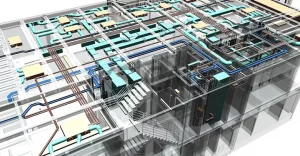
Axium Global can provide expert data centre architectural services for leading global architects, consultants and contractors. Our range of services include creating 3D parametric modelling, creation of data centre design architecture, data centre cooling systems design, BIM coordination, MEP design drafting, architectural drafting, 3D architectural rendering services and 2D and 3D design. We also provide design support services by using BIM software programs, such as Autodesk Advance Steel, Revit, Dynamo for Revit and 3ds Max, V-Ray, SketchUp, Adobe Photoshop and After Effects, Illustrator while using BIM Collaborate Pro.