

How Structural Engineering Shapes Data Centre Performance and Reliability

Standing tall as the silent backbone of almost everything we do – from cloud storage and online banking to streaming and e-commerce, data centres have become essential to modern living. Similar to the human skeleton, their structural framework provides stability, balance and protection to vital organs – the servers, switches and processors that drive modern business operations.
Whether built as colocation facilities serving multiple tenants or hyperscale centres designed for a single digital giant, the structural engineering design of a data centre defines its strength, adaptability and longevity. Just as every bone in the body plays a role in motion and protection, every beam, column and slab in the structural design of a data centre supports continuous digital life.
Structural Integrity: The Spine of Reliability
In structural engineering, most buildings are designed to ensure life safety – protecting people and property. But structural stability in data centres involves mission-critical facilities where the stakes are higher. Here, downtime is the equivalent of a spinal injury: even brief disruption can paralyse global operations, financial transactions and communications.
Data centre design requirements, therefore, exceed standard building codes. Engineers account for redundancy, vibration control and load stability far beyond normal thresholds. The Telecommunications Industry Association (TIA) and Uptime Institute define certification tiers (I-IV) based on reliability, but data centre infrastructure must silently uphold them all – ensuring the facility remains upright, stable and uninterrupted even during extreme conditions.
Bones, Loads & Balance
Just as a human body depends on its bones to distribute weight and motion, data centres depend on carefully calculated load distribution. Under every raised access floor (RAF) lies a hidden network of power distribution units (PDUs), fiber optics and cooling conduits – all adding layers of weight. A typical rack may weigh over 3,000 pounds, yet specifications often remain undefined until late in construction, forcing structural engineers to design for uncertainty.
Here, ASCE 7-22 acts as the anatomy textbook – specifying minimum loads for ‘Computer use – Access floor systems.’ But unlike fixed organs, data centre racks behave in a similar fashion to living, moving organs – with parts swapped, added or removed during operation. That makes structural design services for cable racks must consider them more akin to live loads than static ones. Engineers must, therefore, ensure the ‘skeleton’ adapts and remains balanced even as its internal organs evolve.
Joints & Movement: Managing Vibrations
In a human skeleton, joints absorb movement and prevent fractures. Similarly, a data centre’s structure must resist vibration, seismic motion and equipment shock without transmitting harmful frequencies to sensitive IT systems.
Even minor tremors – or in one experiment, someone shouting near the racks – can cause latency issues. That’s how delicate this nervous system is. Engineers thus brace racks against lateral forces and design vibration-resistant slabs to prevent ‘micro-shocks’ that could jeopardise performance.
In seismic zones, a top-down occupancy strategy (loading the upper floors first) can turn the building into an inverted pendulum, intensifying structural motion. The challenge lies in striking the right equilibrium – enough stiffness to resist vibration, but enough flexibility to avoid cracking under seismic stress.
The Circulatory System: Cables, Loads & Hidden Weight
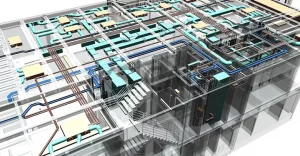
Underneath the raised floor lies the circulatory system of the data centre – a dense web of LAN and fiber-optic cables, PDUs, chilled water pipes and network backbones. These elements, similar to arteries and veins, keep information and power flowing.
But this circulation adds significant collateral loads. Heavy conduits often cluster near the same route, producing uneven stress on the structure. Fibre cables, though seemingly light, can add surprising cumulative weight – especially in plenum-rated or LSZH variants. The result: engineers must anticipate these ‘hidden loads’.
Adaptability: Designing for Evolution
A human skeleton remodels itself in response to stress; likewise, a well-engineered data centre structure anticipates change. As clients demand higher rack density, double-stacked systems or modular expansions, flexibility becomes crucial. Retrofitting live facilities is costly and risky – generating dust, vibrations and even potential shutdowns. That’s why structural engineers must design for future loads and easy scalability right from the foundation phase.
Structural retrofits require extreme caution. Dust containment (through negative air systems) and vibration limits protect IT ‘organs’ from harm. Even fire detection systems, such as VESDA (Very Early Smoke Detection Apparatus), must remain active during upgrades – proof that every modification to the skeleton must preserve the integrity of the living system it supports.
Environmental Defenses: Shielding Against External Stress
Just as bones shield internal organs from injury, the structure of a data centre protects its systems from natural disasters. Designing for tornado loads, uplift pressures and seismic shocks requires advanced planning. Concrete ballasts and topping slabs strengthen roofs that often support cooling towers, water tanks and generators. These additions create a heavier yet more resilient ‘skull’ to protect the delicate electronics below.
Integrated data centre infrastructure solutions, that include premium steel frame design for data centres and trusted structural BIM solutions, ensure speed-to-market, resilience and scalability – the three pillars of modern data centre performance.
The Anatomy of Reliability
If the data centre is the brain of the digital age, structural engineering is its skeleton – silent, strong and indispensable. Every connection, column and cable route mirrors biological precision. Engineers must balance the need for agility with the demand for unwavering stability in structural drawings, structural drafting and detailing services and other structural design services – ensuring that even under immense digital and physical pressure, the structure never falters.
From ASCE standards to Uptime certifications, from vibration thresholds to tornado resistance, the structural framework determines how a data centre breathes, moves and endures. It’s a living, breathing ecosystem – and the bones that hold it together define its form, function, reliability and survival.
Axium Global can provide expert structural engineering design and integrated data centre infrastructure solutions for leading global consultants and contractors as part of its structural BIM solutions. Our range of structural design services include expertise in structural design of data centres, structural stability in data centres, data centre design, structural drawings, structural drafting and detailing services, steel frame design for data centres and structural design services for cable racks, creating BIM families for Revit, electrical plans in Revit, 3D BIM models, BIM coordination, MEP design drafting, architectural BIM modelling and other BIM applications. We also audit model elements using MEP BIM software programs, such as Autodesk Advance Steel, Revit MEP, Revit Structure, Dynamo for Revit and 3ds Max, V-Ray, SketchUp, Adobe Photoshop and After Effects, Illustrator while using BIM Collaborate Pro.